Turtles, Squat, the End of the World and Paradise Heights 🪡
8 July 2026
(The following was first published in January 2025.)
Happy new year! I hope you all got a break, and that you got to spend it with family and friends. I confess that I'm kind of a Grinch around Christmas-time. In my teens and early twenties I found the season very stressful, because I couldn't afford gifts for everyone I felt I owed a gift to, and I didn't have the skills to hand-make a gift. I lived in fear that someone would give me a gift, and I wouldn't have anything to offer in return. In my late twenties and early thirties I had a job in retail, so I had slightly more money (and a staff discount!) but the season was stressful for a different reason.
More shifts, longer shifts, impatient customers, frazzled coworkers. A shop so filled with stock that there's nowhere to put anything, and yet we never seemed to have whatever specific thing the customer was looking for. It's been seven years since I quit my day job, and I still haven't shaken off the dread that starts building in mid-October every year. Maybe it'll linger for the rest of my life.
And now I have children, so the preparations are a lot more complex and come with a significant wallop of both deception ("Santa's watching! The elf has moved!") and guilt ("Are you having a happy childhood??") All the grandparents want to know what the children do and don't like. Have we given them an answer? Is anyone likely to double up? Are both children getting the same number of gifts? Are the gifts of similar percieved value? How can I find the answers to these questions when I can't even hear myself think over the carols and the shouting? "What do you want for Christmas?" some well-meaning loved one would ask me. I just want it to be over! Grinch-Jack would reply, in his head, while meekly mumbling, "I don't know. I'll think about it." (Which I then didn't do.)
I feel the same way about Christmas Day as I do about weddings. In both cases, it's an opportunity to spend time with my friends and family, but turning that into an EVENT—with a menu, a seating plan, a gift registry and so forth—is a nerve-shredding experience. In the weeks leading up to December 25, I can often be found slowly yet frantically driving around and around a crowded shopping centre car park, panickedly grumbling to myself about being expected to pay $30 for a gift that's surely only worth $20 to the recipient, because I don't have a clue what they want, and I can't ask, because then they'll expect me to get that specific thing, which may be hard to find or unaffordable or both, and even in the best case scenario it won't seem thoughtful or be a surprise. Plus, the law of diminishing returns suggests that if you get several gifts all at once, the value of each goes down a little bit. Whose idea was it that everyone in the country should buy a gift for everyone else they know, all on the same day? And what right to I have to complain about any of this, when I'm one of the few people on Earth who isn't currently at risk of losing their home to poverty, a rising tide or a missile? Let's just add some more guilt to the pile, shall we? "I'm trying my best!" I snapped at my wife, when she pointed out that I'd left the fruit salad at home.
However.
Much like a wedding, the day itself was a lot of fun. After the food had been eaten, the presents unwrapped, the police called, the missing five-year-old located, the police dismissed, I started to wonder what on Earth I'd been so worried about.
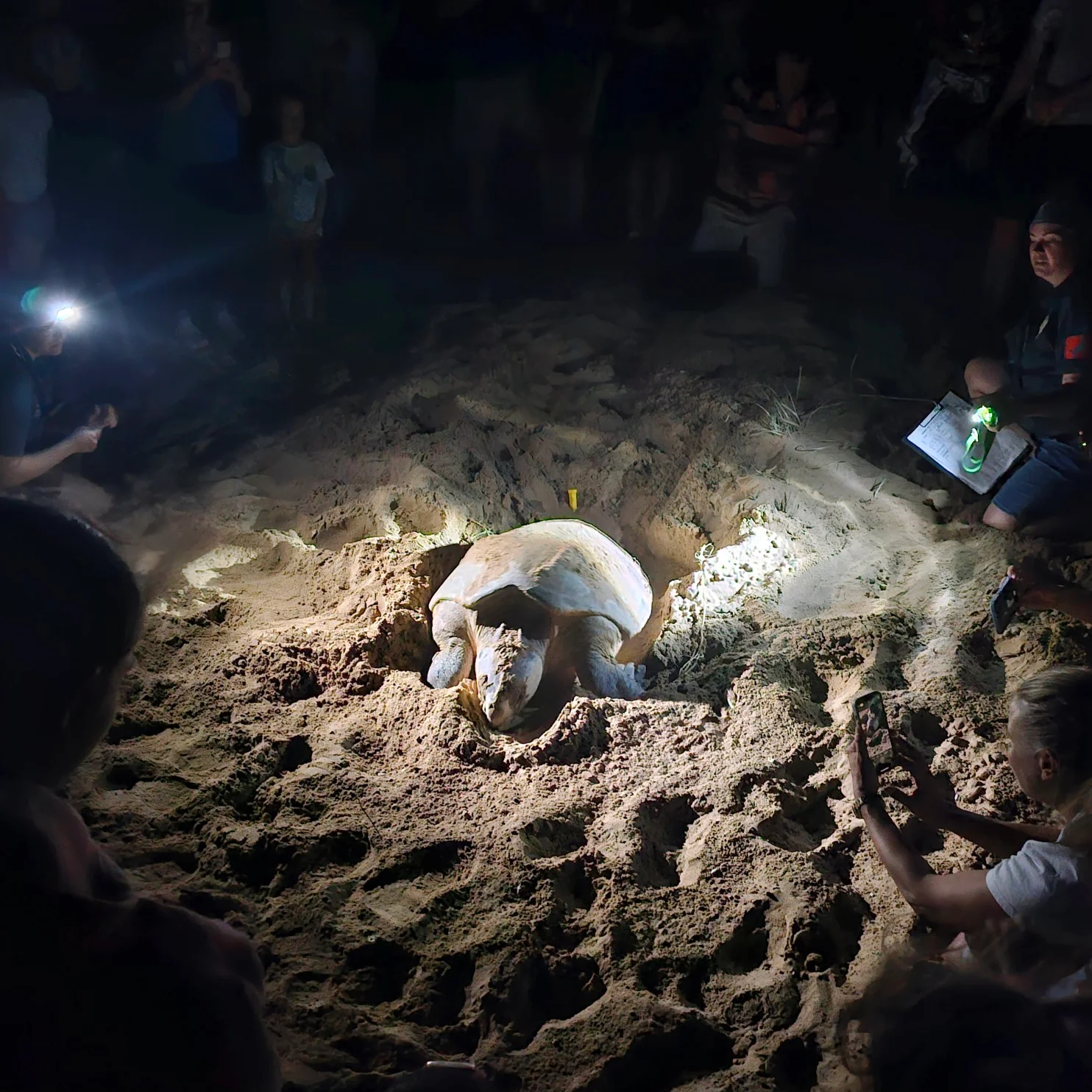
And then I went to Queensland with Venetia and the kids. We watched a turtle lay eggs and swim away. Then we dug up the eggs and hand-delivered them to a safer nest. It was magical.
Even more magically, I could read again. For months I'd been so stressed that my eyes blurred and my brain couldn't turn the words into meaning. I'd drag myself through about one book per month by sheer bloody-mindedness, because if I didn't read, then who the hell was I? But once Christmas day was over, I was relaxed enough to read three books in a single week.
Here they are:
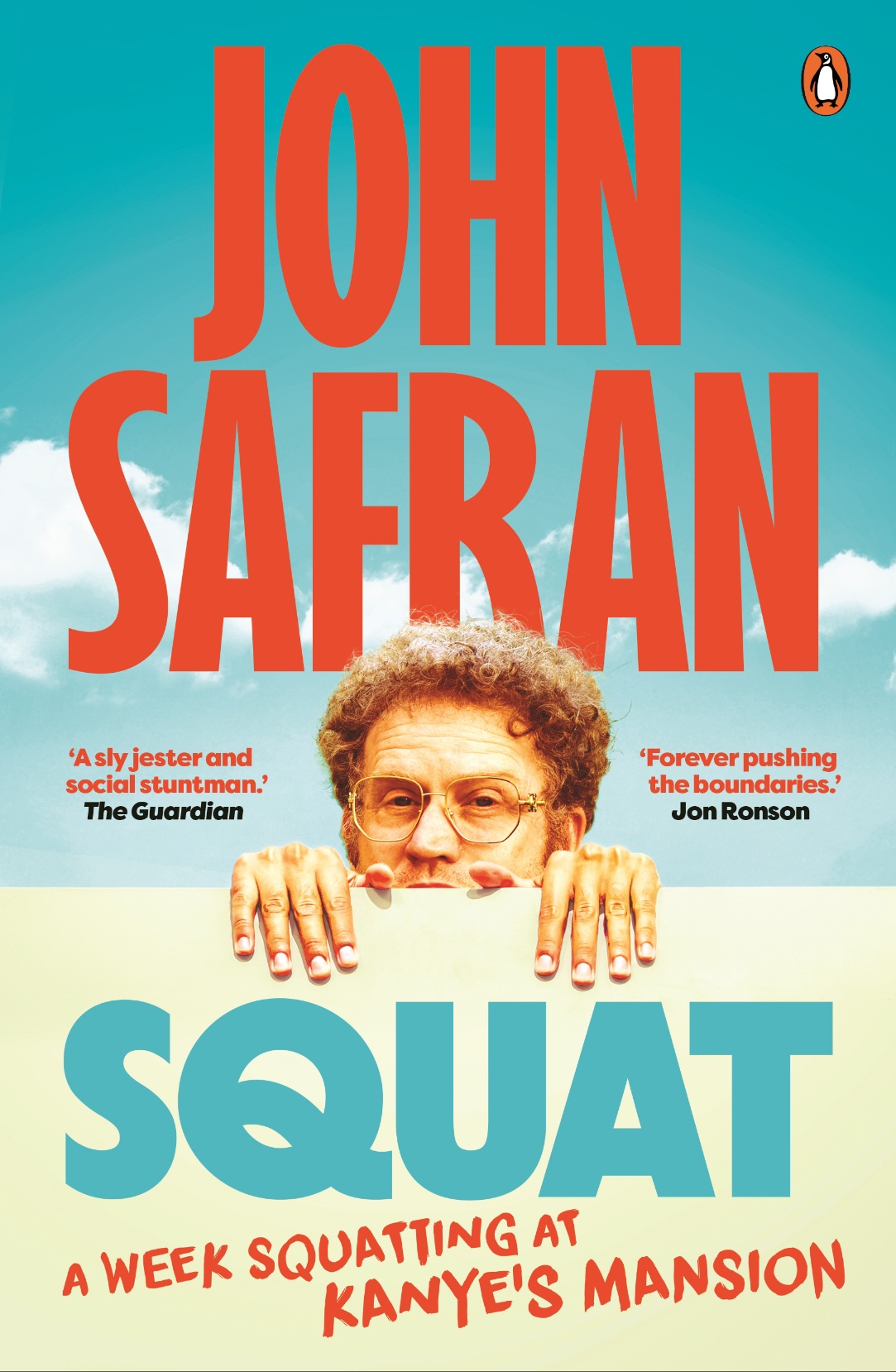
SQUAT
After American rapper Kanye West tweeted his intention to go "death con 3 on the Jewish people," humorous journalist John Safran flew to the USA, wanting to ask West some follow-up questions. Unable to find West, Safran instead broke into one of Kanye's abandoned homes and lived there for a week, trying to get inside the hip-hop star's head.
Squat is really two books smooshed together, and one of them is really good. As he wanders around the US, Safran finds a colourful bunch of rappers, rabbis and rascals to interview, including a homeless guy who was offered the position of West's campaign manager (in a typically eccentric outburst at the VMA awards, West announced his intention to run for President).
In these sections, Safran's musings on what it means to be a secular Australian Jew in 2024 are insightful and (for me) educational. Anyone who enjoyed Safran's previous books will enjoy them.
The other book, the one about Safran squatting in Kanye's house, is merely OK. Safran's gift is his willingness to ask difficult questions of dangerous people, and in the mansion (spoiler warning) there's no-one for him to talk to. He tries to keep things interesting by repeatedly putting his own life in unnecessary danger, climbing on things that shouldn't be climbed, walking around barefoot on broken glass like John McClane because he "forgot" his socks, and so forth. He also "forgets" his medication. (Not sure I buy that, Saffo.) But ultimately, Safran doesn't have much to show for all the crimes he committed (which include not only breaking and entering, but also vandalism and theft). His reflections on the ethics of his investigation never get far beyond "maybe this is unethical".
Prior to reading this book, the only thing I knew about Kanye West was that he had bipolar disorder. This goes some way towards explaining (though perhaps not excusing) his history of erratic behaviour and bigoted outbursts. As at least one Britney Spears fan has noted, if Kanye West was a woman, he would have a conservatorship by now. The story of a (by most accounts) brilliant musician with a tenuous grip on reality getting exploited and radicalised would be an interesting one, but Safran refuses to tell it, instead searching futilely for method amidst Kanye's madness. Suspiciously, Squat doesn't include any references to West's illness. Perhaps Safran guessed it would seem like punching down to break into the home and steal the belongings of a guy whose illness had cost him his marriage and most of his wealth. Then again, I might feel differently if I belonged to one of the groups that West had threatened, or if he'd stolen a microphone from me at an award ceremony.
Either way, Squat was unputdownable. (I was on holiday - if it hadn't been unputdownable, I would have put it down.)
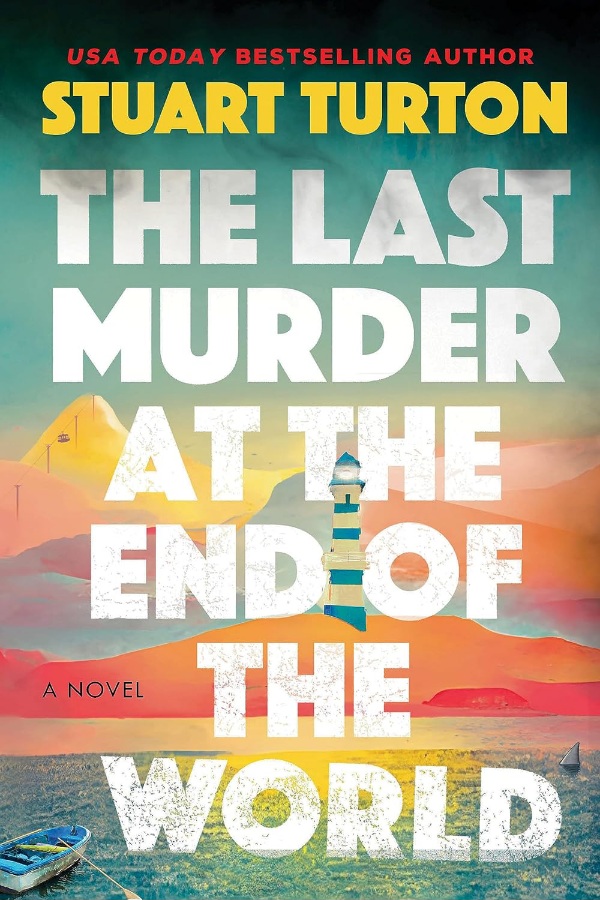
THE LAST MURDER AT THE END OF THE WORLD
On an idyllic island surrounded by a deadly fog, Emory is very unpopular, because she's the only person who ever asks any questions. Questions like, why does everyone die on their 60th birthday? Why do we all lose consciousness at 8:45 pm every night, and why do we wake up with dirt on the soles of our feet? And who stabbed my friend and left them in a burning building while we were all asleep?
The first half of this book is terrific, give or take a nasty case of unnecessaryprologitis. The narrator is a stochastic, mind-reading AI named Abi, and Stuart Turton uses her to great effect, peeling back the layers of this sinister setting one by one while also peering deep into the souls of the characters on the island. The tensions between Emory, her daughter and her father are particularly engaging.
I'm reminded of Snowpiercer, in which the last humans hurtle around and around the snap-frozen Earth on a thousand-carriage-long train which can never, ever stop, otherwise the cold will kill everyone on board. In one review (of the TV series, not the movie or the graphic novel) a critic complained that the filmmakers had ruined the story by shoe-horning in a murder. At the time, I strongly disagreed. Sure, the setting should be connected to the plot, but the setting shouldn't be the plot. The world's last homicide cop searches a giant train for the world's last serial killer? All aboard! (After the cop solved the murder, I soon lost interest in the show.)
Now I sympathise a little more with that critic. The second half of The Last Murder at the End of the World becomes a fairly standard game of Cluedo, complete with locations, suspects, and potential murder weapons. Much like a game of Cluedo, the suspects don't even know if they're guilty (because their memories have been erased). This is an interesting idea in theory, but in practise, it makes the interrogation of the suspects a bit repetitive. And there's nothing sci-fi about the clues--it's the same "angle of the blade suggests a tall killer" and "fragment of a fingernail found in the victim's cheek" type stuff that you'd find in any episode of NCIS.
Having said that, there are some great twists along the way, and I found the ending satisfying in terms of theme, plot and character (unlike the ending of this review, which feels a bit underwhelming given that I enjoyed the book so much).
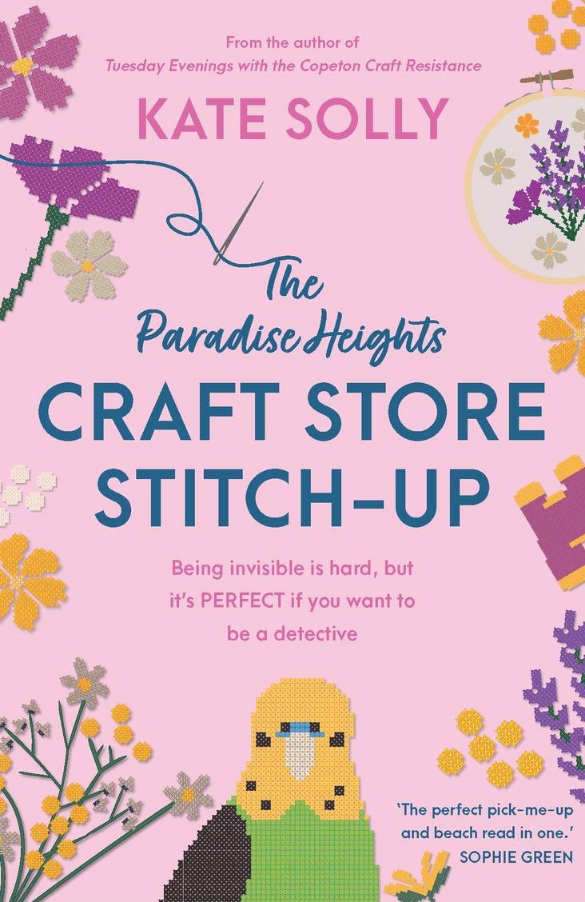
THE PARADISE HEIGHTS CRAFT STORE STITCH-UP
Fleck Parker is a full-time mum of three, struggling to make friends with the other parents at school drop-off. Then she does make a friend, Trixie, who invites her to learn crochet at a nearby charity shop. What a nice ending! Book over, right?
Well, no. When Trixie, is accused of stealing $20,000 from the shop, Fleck takes it upon herself to clear her new friend's name. After all, Fleck is good at Wordle--how much harder could investigating a theft be?
On the one hand, the stakes couldn't be lower. There's no dead body. No world-ending fog. The charity hasn't even called the police--they just want their money back. But who was it who said "the lowest stakes are the highest stakes"? (Maybe it was me.) I was far, far more invested in seeing Trixie get out from under a $20k debt she shouldn't owe than I was in seeing Captain America save the universe from the Infinity Glove, or whatever.
It's refreshing to find an amateur sleuth who reads like a genuine amateur, rather than one who just feels like a cop wearing an apron. Fleck starts from less than zero--not only is she inexperienced, frazzled and exhausted, but whenever she's on a stakeout, she has a baby on one nipple and two other kids fighting for possession of her binoculars. "Sorry, I am listening, please go on," she tells a witness, while watching one of her children block the top of the slide at a nearby playground. For this reason, seasoned crime readers will guess the true culprit long before Fleck does (although they may not guess nature of the crime. I sure didn't.)
But this isn't the sort of book you read for the mystery alone. You read it for humour, relatability and (if you're me) to admire the deft characterisation. Look how efficiently Kate Solly captures even the bit players:
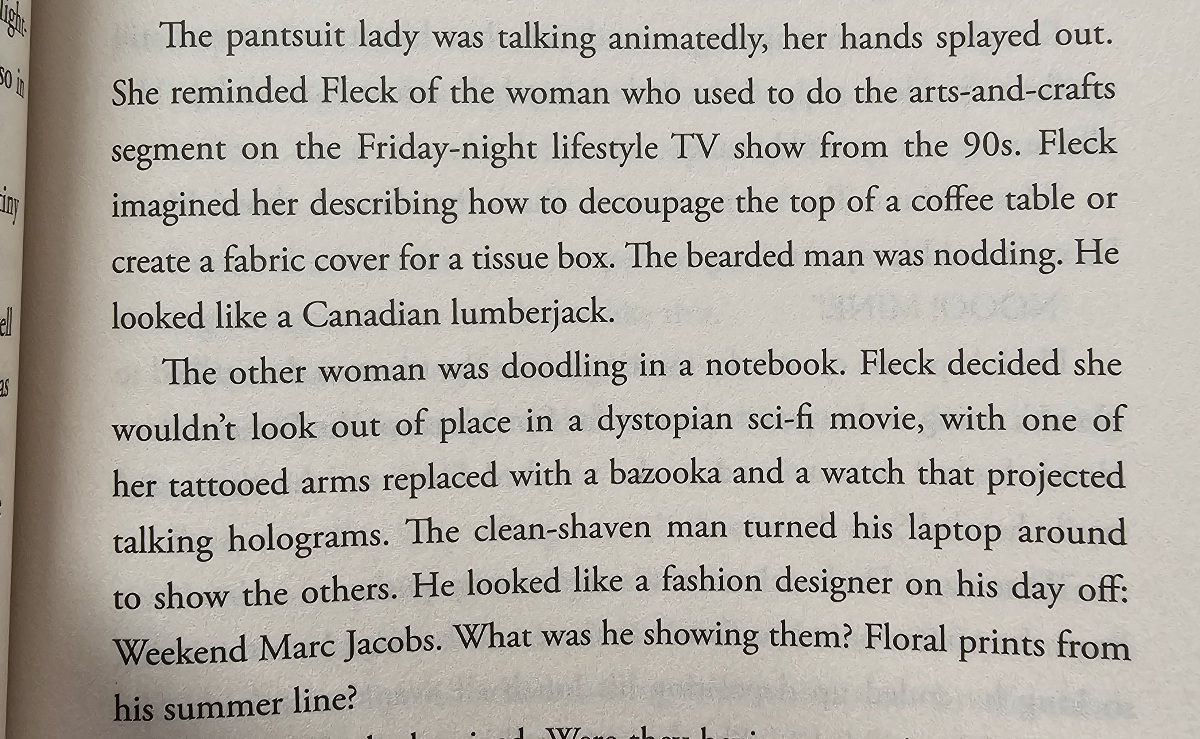
And those people aren't even important! I would kill to be able to describe characters like that. (OK, maybe not kill, but I would definitely steal $20,000 from a charity.)
Disclosure: I think I got a free copy of this book? I met Kate Solly once, and she was very nice. I wouldn't put it past her to send me a freebie. Note to self - keep better records, for transparency purposes.
That's all for now, folks! Stay rad.
Jack